Caymons: A Bold Retro Sans for Modern Branding
In the landscape of digital typography, few styles manage to balance nostalgia with contemporary utility as effectively as the bold, condensed retro sans genre. Caymons enters this space not merely as another vintage-inspired typeface, but as a distinct tool designed for high-impact visual communication. For designers, marketers, and creative professionals seeking to inject energy into their projects without sacrificing legibility, Caymons offers a compelling solution rooted in the aesthetic traditions of the 1980s and 1990s. Its value lies in its ability to evoke a specific era while remaining functional for modern web design, event branding, and large-scale display applications.
The Distinctive Character of Reverse Contrast
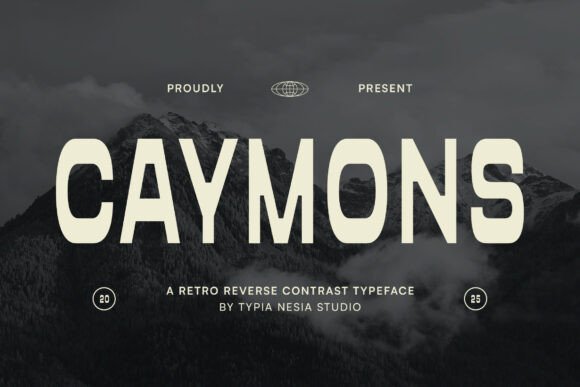
What immediately sets Caymons apart from standard geometric or grotesque sans-serifs is its unique reverse contrast style. In traditional typography, contrast usually refers to the variation between thick and thin strokes within a single letterform. However, Caymons manipulates this concept to create a striking, almost architectural silhouette. The strokes are heavy and substantial, yet the spacing and internal counterforms are engineered to prevent the text from becoming a solid block of ink. This approach results in a font that feels dense and powerful at a glance but retains enough structural integrity to remain readable even at smaller sizes.
This reverse contrast technique gives the typeface a dynamic tension. It mimics the hand-painted signage and stenciled graphics popular in urban environments during the late 20th century. When applied to headlines, the effect is immediate and commanding. Unlike fonts that rely on extreme stylization which often limits their use to decorative purposes only, Caymons maintains a level of neutrality that allows it to function as a primary display font. It does not shout through gimmicks; rather, it commands attention through its sheer presence and confident geometry.
Practical Applications in Branding and Design
The versatility of Caymons makes it particularly well-suited for industries where visual impact is paramount. Music festivals, concert posters, and urban event branding frequently utilize this aesthetic because it resonates with audiences who appreciate street culture and retro-futurism. The condensed nature of the font allows designers to fit significant amounts of information into narrow spaces, such as ticket stubs, wristbands, or vertical banners, without compromising the visual weight of the message.
Beyond event marketing, Caymons serves as an excellent choice for logo design and badge creation. Its bold forms hold up exceptionally well when scaled down for app icons or social media avatars, ensuring that the brand identity remains recognizable across various platforms. For web designers, the font provides a strong anchor for hero sections and call-to-action buttons. The uppercase characters, in particular, offer a sturdy foundation for navigation menus and section headers, guiding the user's eye through the content hierarchy with authority.
- Music and Entertainment: Ideal for album covers, tour posters, and merchandise where a gritty, authentic vibe is required.
- Urban Apparel: Perfect for t-shirt graphics and streetwear labels that draw inspiration from skate and hip-hop cultures.
- Digital Interfaces: Effective for landing pages and promotional emails that need to stand out in a crowded inbox.
- Editorial Design: Suitable for magazine covers and feature headlines that aim to capture a nostalgic yet modern tone.
Technical Usability and Multilingual Support
A font's aesthetic appeal is only half the battle; its technical execution determines its long-term viability in professional workflows. Caymons addresses common pain points found in many display fonts by offering robust multilingual support. This inclusion expands its utility beyond English-speaking markets, allowing international brands and creators to maintain consistent branding across different languages. The comprehensive character set includes full uppercase and lowercase alphabets, numerals, punctuation, and a selection of decorative ligatures.
The presence of lowercase characters is a significant advantage for a font in this category. Many retro-style typefaces limit themselves to all-caps usage, which can feel aggressive or outdated if used for extended body copy. With Caymons, designers have the flexibility to mix cases, creating more nuanced typographic hierarchies. The lowercase letters retain the same bold personality as the uppercase counterparts but offer a softer entry point for secondary headlines or pull quotes.
Furthermore, the inclusion of decorative ligatures adds a layer of customization. These special character combinations allow designers to add subtle flourishes to logos or titles without needing to manually adjust vector paths. This feature streamlines the design process, reducing the time spent on manual kerning and glyph manipulation. For freelancers and agencies working under tight deadlines, these built-in efficiencies translate directly into better project management and faster turnaround times.
Performance in Real-World Scenarios
When evaluating Caymons for real-world application, consistency is key. The font performs reliably across both print and digital mediums. In print, the thick strokes ensure that the text remains crisp even when printed on textured paper or using screen printing techniques common in apparel production. Digitally, the font renders cleanly on high-resolution displays and scales appropriately for responsive web layouts. However, like any condensed bold font, it requires careful consideration regarding line height and letter spacing (tracking) to avoid visual crowding.
Designers should be mindful of the font's density when pairing it with other typefaces. Because Caymons is so visually dominant, it pairs best with simpler, lighter sans-serifs or neutral serifs for body text. Attempting to pair it with another highly stylized or heavy font can result in a chaotic visual experience. The goal is to let Caymons serve as the focal point, providing the "retro edge" while supporting typefaces handle the informational load.
Ideal Audience and Strategic Fit
Caymons is specifically tailored for adults aged 20 to 50 who operate in creative, entrepreneurial, or marketing roles. This demographic spans from freelance graphic designers and small business owners to established marketing teams and publishers. For entrepreneurs building a brand identity from scratch, Caymons offers a shortcut to a mature, established look that suggests heritage and confidence. It appeals to those who understand that nostalgia is a powerful emotional trigger in consumer behavior.
For educators and serious hobbyists involved in community projects or local event planning, the font provides a professional-grade asset that elevates the quality of promotional materials. It bridges the gap between amateur design and polished commercial output. The font is less suitable for formal corporate communications or academic publications where a conservative, understated tone is preferred. Its strength lies in its ability to disrupt and engage, making it a strategic choice for campaigns that require high engagement rates and memorable visual identities.
Considerations and Limitations
While Caymons is a powerful tool, it is not a universal solution. Its bold, condensed nature means it is primarily intended for display purposes. Using it for long-form body text can lead to reader fatigue due to the lack of white space within the characters. Designers must adhere to best practices regarding font size and leading to ensure readability. Additionally, the retro aesthetic, while timeless in certain contexts, may feel dated if overused or applied to projects targeting a strictly futuristic or minimalist audience.
Another consideration is the competition within the retro sans market. There are numerous fonts available that mimic the 80s and 90s style. To maximize the value of Caymons, users should leverage its specific features—such as the reverse contrast and extensive ligature set—to create designs that cannot be easily replicated with generic alternatives. The unique stroke modulation of Caymons provides a signature look that helps brands differentiate themselves in saturated markets.
Conclusion
Caymons represents a thoughtful synthesis of vintage inspiration and modern functionality. It offers designers a reliable, versatile typeface that captures the energetic spirit of past decades while meeting the technical demands of today's digital environment. Whether used for a music festival poster, a startup logo, or a bold website header, Caymons delivers the visual impact necessary to cut through the noise. By understanding its strengths, limitations, and ideal use cases, professionals can integrate this font into their workflow to create work that is not only aesthetically pleasing but also strategically effective. For those seeking a typeface that balances nostalgia with power, Caymons is a resource worth exploring and implementing.